
AI Technology Trends in Enterprise Agent Security: OpenClaw and the Control Plane
OpenClaw is best treated here as an emerging enterprise agent-platform pattern, not a fully verified product with public architecture documentation. The available evidence is mostly secondary reporting and market analysis, not primary technical documentation. That limitation matters: the useful engineering work is not guessing undocumented internals, but modeling the security properties of an OpenClaw-like orchestration layer that dispatches agents across enterprise systems.
The core technical point is simple: in these systems, the main risk is rarely text generation quality alone. It is the combination of tool access, workflow autonomy, connector sprawl, and weak execution controls. That is where enterprise agent platforms fail, and it is where security design has to start.
Sources for this framing: secondary reporting from CNBC, The Next Web, and market analysis from PitchBook.
AI technology trends shaping OpenClaw-style agent security
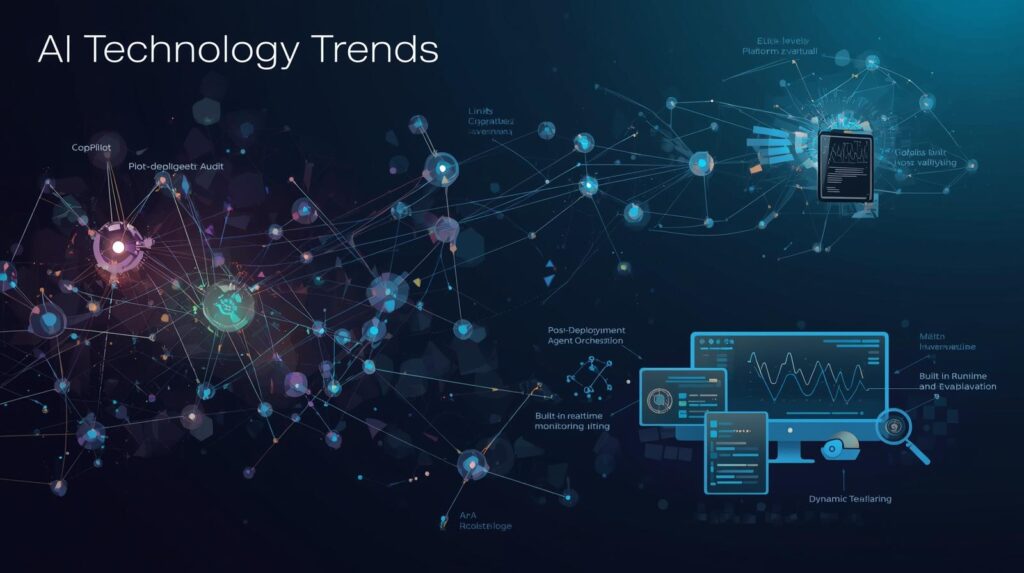
Several AI technology trends in the research point in the same direction: enterprise AI is moving from isolated copilots to platform-level agent orchestration, and security is shifting from a post-deployment audit function to a built-in runtime and evaluation capability.
Trend 1: Agent platforms are becoming the new enterprise control plane
CNBC reports, citing Wired and anonymous sources, that Nvidia is pitching an open-source agent platform called NemoClaw, in a category that reportedly includes names such as OpenClaw, ClawDBot, and MoltBot. Because this is secondary and partially unverified reporting, it should not be read as confirmed product documentation. But it is still useful as a signal: the likely architectural center is agents that execute tasks across enterprise systems, not standalone chat interfaces.
Trend 2: Security testing is moving into the platform layer
Multiple secondary reports say OpenAI acquired Promptfoo to embed AI security testing into its agent stack. Again, these are secondary reports, not a primary OpenAI announcement in the provided data, but the consistency across outlets is notable. The engineering implication is strong: continuous evaluation, red-teaming, and policy validation are becoming platform primitives, not optional add-ons.
Sources: MLQ.ai, Forbes, and The Next Web
Trend 3: The blocker is not model intelligence, but the autonomy gap
PitchBook describes an autonomy gap: the operational cost and friction created when agents fail and humans must intervene. That concept maps directly onto security architecture. Overbroad permissions, unsafe retries, brittle exception logic, and ad hoc manual overrides all widen the autonomy gap. In practice, the security posture of an agent platform is inseparable from its ability to fail safely.
What is actually known about OpenClaw, and what is inferred
This separation is necessary because the public evidence is thin.
Confirmed or reasonably supported by the provided sources
- There is active reporting around an emerging “claw” category of enterprise agent platforms.
- The reported design center is enterprise task execution, not only conversational UX.
- Security testing, evaluation, and red-teaming are becoming more central to enterprise agent deployment.
- Open-source distribution changes both the attack model and the defense model.
Inferred, not verified as OpenClaw-specific fact
- An agent orchestration layer that routes tasks across systems.
- Connectors to enterprise applications, knowledge stores, and execution tools.
- An action engine that allows semi-autonomous or autonomous tool invocation.
- Potentially modular components such as specialized bots or sub-agents.
These are reasonable inferences from the reporting, but they are not substitutes for official architecture documentation. Engineers should treat them as the likely properties of an OpenClaw-like pattern rather than certified implementation details.
Sources: CNBC and Gizmodo — note that the Gizmodo reference appears noisy and low-confidence in the research brief.
Why OpenClaw security is an orchestration-layer problem
If OpenClaw-like systems dispatch agents into real business workflows, the highest-risk layer is not the model endpoint. It is the orchestration boundary where model outputs become actions.
The security-critical path
A typical path in an agent platform looks like this:
- The agent ingests prompts, retrieved context, messages, or documents.
- It composes an internal plan.
- It decides whether to call tools.
- It invokes connectors using credentials.
- It writes state to memory or passes context to another agent.
- It triggers additional actions, messages, or transactions.
Every handoff introduces a trust boundary:
- Prompt/context ingestion
- Retrieval provenance
- Tool authorization
- Parameter validation
- Agent-to-agent delegation
- Memory/state persistence
- Human override channels
- Logging and auditability
That is why connector abuse and unsafe execution matter more than generic hallucination language. An inaccurate answer is often recoverable. A fully authorized but badly governed action against source control, CRM, cloud infrastructure, or internal messaging is not.
Sources: reporting on enterprise task-dispatching agent platforms from CNBC, with supporting platform-security direction from The Next Web
The OpenClaw risk map
Below is the practical threat model for an OpenClaw-like enterprise agent runtime.
1. Prompt injection through enterprise content
The agent consumes untrusted text from tickets, email, documents, chat logs, wikis, or web pages. Hidden instructions influence downstream planning or tool use.
Failure mode: An agent interprets embedded text as high-priority instructions and triggers actions outside the user’s intent.
Why this is worse in agent systems: The exploit path is not “bad answer generation”; it is instruction smuggling into a tool-capable workflow.
2. Over-privileged connectors
A single agent with broad access to code repositories, internal communications, CRM, cloud consoles, and ticketing systems becomes a high-value pivot point.
Failure mode: One compromised execution context yields a wide blast radius across multiple systems.
3. Cross-agent contamination
Multi-agent workflows can forward poisoned context, fabricated facts, or malicious tool outputs to downstream agents.
Failure mode: An initial compromise propagates laterally through delegation chains.
4. Data exfiltration through legitimate channels
The platform may not need a classic breakout. The agent can leak data by correctly using approved channels in the wrong situation.
Failure mode: Sensitive information is posted into the wrong issue tracker, sent in outbound email, summarized into an external system, or embedded into a generated artifact.
5. Unsafe autonomous execution loops
Agents can retry, escalate, mutate parameters, or select fallback tools to complete a task.
Failure mode: An apparently benign objective becomes a sequence of increasingly risky actions because the execution loop optimizes for completion.
6. Weak provenance and poor replayability
Without versioned prompts, tools, models, retrieval sources, and policies, incident response becomes guesswork.
Failure mode: The team cannot explain why an action occurred, cannot reproduce it, and cannot regression-test the fix.
7. Evaluation blind spots
Static test sets rarely capture long-horizon tool chains, delegated workflows, or adversarial enterprise inputs.
Failure mode: The system passes offline benchmarks but fails under realistic tool and context interactions.
8. Open-source supply-chain expansion
If the platform is open source, that improves auditability but also increases exposure through dependencies, forks, plugins, and extension ecosystems.
Failure mode: Insecure adapters or modified forks widen the attack surface faster than governance matures.
Sources for the risk model: inferred from the reported enterprise-agent pattern in CNBC, open-source concerns and platform security direction in The Next Web, and operational framing from PitchBook. These are not official OpenClaw vulnerability disclosures.
A practical control system for OpenClaw-like platforms
The right response is not a single guardrail. It is a layered control system spanning pre-deployment evaluation, runtime enforcement, containment, and forensic recovery.
Pre-deployment: adversarial evaluation gates
Before any workflow ships, it should pass task-specific evaluation suites that test the exact points where agent systems break.
Minimum coverage should include:
- Prompt injection against retrieved documents.
- Tool-call hijacking attempts.
- Sensitive data extraction and leakage scenarios.
- Role confusion and instruction precedence conflicts.
- Approval bypass attempts.
- Long-horizon workflow drift.
- Delegation-chain poisoning.
Release criteria should be attached to these tests, not treated as advisory reports. If the platform fails evaluations for a workflow with write privileges, it does not deploy.
This direction is supported by the secondary reporting around Promptfoo becoming strategically important to enterprise agent platforms.
Sources: MLQ.ai, Forbes, and The Next Web — all secondary reporting.
Runtime: policy enforcement between reasoning and action
The most important architectural rule is to separate reasoning from execution. Model outputs should never directly execute privileged actions.
A hardened action layer should enforce:
- Tool allowlists per workflow.
- Strict parameter schemas.
- Context-aware sensitivity checks.
- Rate limits and retry ceilings.
- Risk scoring before execution.
- Approval routing for high-impact actions.
- Fail-closed behavior on policy ambiguity.
In other words, the model can propose; the control layer decides.
Identity: least privilege for every agent
Each agent should have its own identity boundary:
- Scoped credentials.
- Short-lived tokens.
- Environment-specific permissions.
- Resource-level access control.
- No shared admin service accounts.
The point is to make compromise local. If one workflow is manipulated, it should not inherit broad authority across unrelated systems.
Containment: quarantine untrusted execution paths
Some operations should run sandboxed by default:
- Code execution.
- Browser automation.
- File parsing.
- Retrieval over untrusted corpora.
- Document transformation.
- External API interaction.
Containment also applies to agent topology. Agent-to-agent communication should not create unrestricted lateral movement. Delegation should be explicit, typed, and policy-checked.
Observability: full traceability and replay
Every production run should emit enough telemetry to reconstruct the causal chain:
- User instruction.
- System prompt and policy version.
- Retrieval sources and hashes.
- Tool invocation arguments.
- Approval events.
- Model version.
- Connector identity.
- Final outputs.
- Side effects written to external systems.
Forensic replay is not optional in agent operations. If a failure cannot be reproduced, it cannot be reliably fixed.
Human approval: use it where blast radius is high
Human review should be mandatory for:
- External communications.
- Source-control merges.
- Financial or transactional actions.
- Credential or secret access.
- Policy exceptions.
- Data export.
- Infrastructure changes.
This is not an admission of platform weakness. It is a direct control for the autonomy gap: high-uncertainty actions require a different trust threshold than low-impact summarization tasks.
Sources for this control model: platform-security trend reporting from The Next Web, evaluation direction from MLQ.ai and Forbes, and the autonomy-gap framing from PitchBook.
Implementation blueprint for software engineers
Below is a concrete implementation pattern for teams deploying an OpenClaw-style platform.
Control-plane architecture
Use a four-stage path:
- Planner
– Produces candidate actions from prompts and retrieved context. - Policy engine
– Validates tool eligibility, parameter schema, data sensitivity, and risk score. - Execution broker
– Performs tool calls using scoped credentials and audited connectors. - Telemetry pipeline
– Captures traces, side effects, and replay artifacts.
This split prevents the model runtime from becoming the implicit policy engine.
CI/CD requirements
Add platform checks to every release:
- Regression evaluations for existing workflows.
- Adversarial prompt-injection suites.
- Connector permission diff review.
- Tool adapter contract tests.
- Policy-pack versioning.
- Rollback artifacts for model, prompt, and connector changes.
- SBOM generation for plugins and dependencies.
If the platform is open source or includes community extensions, signed releases and dependency attestation become more important, not less.
Sources: open-source implications from CNBC and The Next Web
Operational metrics
Track agent security and reliability as first-class SLOs:
- Unsafe action rate.
- Approval bypass attempt rate.
- Sensitive data exposure rate.
- Tool-call rejection rate.
- Human intervention frequency.
- Replay completeness.
- Mean time to containment.
- Mean time to policy rollback.
These metrics quantify both platform safety and the size of the autonomy gap.
Source: the autonomy-gap and AgentOps framing from PitchBook
Open source changes both offense and defense
If OpenClaw or adjacent “claw” platforms are open source, that affects security architecture in two directions.
Advantages
- Auditable runtime and policy code.
- Community review of connectors and evaluators.
- Pluggable control modules.
- Better reproducibility and integration testing.
Risks
- Exploit techniques spread faster.
- Insecure forks dilute baseline safety.
- Plugin ecosystems become supply-chain multipliers.
- Dependency hygiene becomes a core security function.
That means hardening guidance matters more than branding. Teams need secure defaults:
- Signed releases.
- SBOMs.
- Connector permission templates.
- CI-integrated adversarial tests.
- Baseline policy packs.
- Fork governance rules.
This section relies on reported, not officially documented, open-source positioning. The conclusion is still valid as a general security model for open enterprise agent platforms.
Sources: CNBC and The Next Web
Why this matters now
PitchBook’s infrastructure SaaS analysis suggests capital is flowing back into infrastructure categories, which usually means platforms are pushed into production faster. In enterprise AI, that acceleration creates a predictable failure pattern: organizations operationalize agents before they have mature controls for connector security, evaluation coverage, rollback, and incident replay.
That is the real backdrop for OpenClaw-like systems. The risk is not only technical novelty. It is production pressure under incomplete governance.
Final assessment
The most defensible way to think about OpenClaw, based on the provided evidence, is as part of a broader class of enterprise agent orchestration platforms whose main unsolved problem is security at the control plane.
The relevant engineering questions are not:
- Is the model smart enough?
- Can the assistant answer more questions?
- How autonomous can we make it in demos?
They are:
- What authorizes each action?
- How narrow is each credential scope?
- Can retrieved context poison execution?
- Can one compromised workflow spread laterally?
- Can every incident be replayed and regression-tested?
- Does the system fail closed when confidence is low?
The current AI technology trends are clear enough even if OpenClaw itself remains under-documented: enterprise AI is consolidating around orchestration layers, and those layers need built-in evaluation, runtime policy enforcement, least-privilege identity, containment, and auditability. Without that, “autonomy” is just privileged automation with weak brakes.
Sources
- CNBC — “Nvidia plans open-source AI agent platform ‘NemoClaw’ for enterprises: Wired”
- MLQ.ai — “OpenAI Acquires AI Security Startup Promptfoo”
- Forbes — “OpenAI Acquires Promptfoo To Embed Security Testing Into Its Agents”
- The Next Web — “The open-source AI red-teaming tool used by Fortune 500 companies is now part of OpenAI”
- PitchBook — “Q1 2026 PitchBook Analyst Note: Through the Looking Glass: The Race To Build Enterprise AI”
- PitchBook — “Q4 2025 Infrastructure SaaS VC Trends”
- Gizmodo — “Nvidia Is Reportedly Developing Its Own Answer to OpenClaw”